Lynwood's median home was built in 1954, and about 3,999 of its 15,896 housing units date from the 1950s. Another 3,199 come from the 1940s and 3,209 from 1939 or earlier. Plumbing in houses this age has had a long time to wear, and a leak inside a wall or a ceiling can stay out of sight until a stain, a smell or a water bill gives it away.
Key takeaways
- Older homes can leak inside walls, ceilings and floors long before a visible puddle appears.
- Warning signs include stains, bubbling paint, a musty smell, the sound of running water and a rising water bill.
- Shut off the water at the main valve for the house, then close the fixture valve if the leak is on a single branch.
- The plumber repairs the pipe first, and the restoration team then opens, dries and measures the wet walls and ceilings.
- Renters should report a leak in writing, since 8,160 of the city's occupied homes are rented.
How an older housing stock shows up in leaks
The numbers point one way. About 1,978 units were built in the 1960s and 1,697 in the 1970s, while only about 585 date from 2000 to 2009 and 106 from 2010 to 2019.
Most of the city's homes have been in service for a long time.
Age alone does not make a pipe leak. A house that has been lived in for decades is more likely to have worn valves, fittings and connections, and a small failure inside a wall can run unseen.
About 9,615 of the units are detached single family homes and about 1,547 are attached, so the same kind of leak can stay in one house or cross a shared wall.
Warning signs inside the house
A hidden pipe leak seldom looks like a burst. It looks like a house that is slightly off.
- A brown or yellow stain that grows on a ceiling or at the bottom of a wall.
- Paint that bubbles, peels or turns soft near a bathroom, kitchen or water heater.
- A musty smell in one room that stays after the windows are opened.
- The sound of running or dripping water when nothing is on.
- A warm spot on a floor or wall, which can mean a leaking hot water pipe.
- A water bill that rises with no change in how the household uses water.
Reading the clues
The place where the water shows is often not the place where it starts. Water follows framing, pipes and gravity before it reaches a surface.
The leak source finder helps sort a wall pipe leak from a water heater, a roof leak or an appliance.
A stain on a ceiling
It may come from a bathroom or a supply pipe above, or from the roof. A stain that appears after rain and dries up in dry weather suggests the roof, while a stain that grows in dry weather suggests a pipe.
A damp wall or baseboard
Check the room on the other side of the wall. A bathroom, kitchen or laundry room that shares the wall is a likely source.
The meter
With every fixture off, a water meter that keeps turning confirms water is escaping somewhere between the meter and the fixtures.
What to do first
The main goal is to stop water flowing into the wall.
- Find the main shutoff valve for the house and close it.
- Photograph the stain, the wet area and the meter reading with the date.
- Keep people and furniture away from a sagging ceiling, and turn off lights that sit in a wet area.
- Call a plumber to find and fix the pipe.
- Call the restoration team to measure how far the water spread.

How walls and ceilings are opened and dried
A moisture meter and a thermal camera show how far the water traveled, so the opening can be sized to the wet area and not to the whole room.
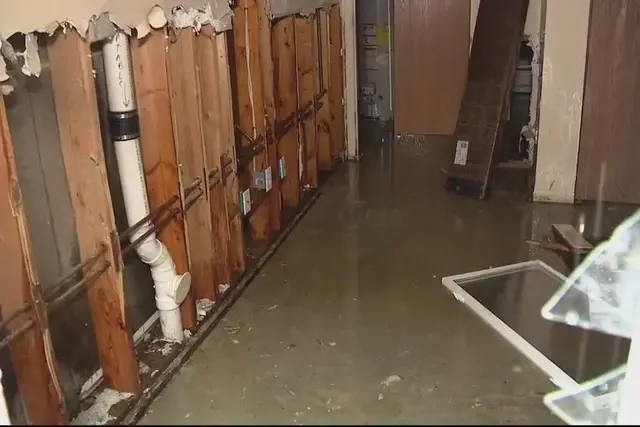
Drywall that is soft, stained or wet to the touch is cut out, and wet insulation is removed. The framing behind it is left open to dry.
This work is described under burst and pinhole pipe leaks.
- Air movers and dehumidifiers run until the readings match a dry reference.
- Baseboards and trim are taken off so water trapped behind them can escape.
- Cabinets and flooring beside the wet wall are checked for moisture.
Catching the next leak sooner
A few habits help any older house, whether it is owned or rented. They cost little and they move the discovery of a leak from months to days.
- Learn where the main shutoff valve is and make sure it turns.
- Look under sinks and behind toilets twice a year for damp cabinets, rust or corrosion on fittings.
- Read the water meter at night with everything off, and read it again in the morning.
- Fix a dripping faucet or a running toilet instead of waiting, since small leaks wear on valves.
- Report a stain right away, even a small one, instead of painting over it.
Owners, tenants and shared walls
Lynwood has about 7,223 owner occupied homes and 8,160 renter occupied ones, so many leaks involve a landlord. A tenant who notices a stain should send the landlord a dated message with photos.
Attached homes and small buildings add a second concern. About 444 units are in 2 unit buildings and 1,108 in buildings of 3 or 4 units, so a leak can reach the household on the other side of a wall.
After the pipe is repaired, structural drying removes the moisture left in the walls. For other kinds of water loss, see water damage restoration for local homes.
Questions
Can a leak inside a wall be found without opening it?
Often, yes. A plumber can use moisture meters, thermal cameras and listening tools to narrow down the spot, so the opening can be small.
Is a ceiling stain always a pipe leak?
No. A roof leak, a bathroom above, an air conditioner drain or a water heater can all leave a similar stain, so the source is confirmed before anything is cut.
Does one leak mean the whole house needs new pipes?
Not by itself. A plumber judges the condition of the pipes and fittings and recommends a repair or a larger replacement based on what is found.
Why can't the drywall just be left to dry?
Drywall that stays wet loses strength and can hold moisture against the framing. Opening it lets air reach the framing, and the damaged sections can be replaced.
What if the main shutoff valve will not turn?
Do not force it with a tool that could break the valve. Call a plumber right away, and keep towels and buckets under the leak while waiting.
What should a renter do about a hidden leak?
Tell the landlord or manager in writing, photograph the stain or the wet area and keep a copy of the message. The landlord arranges the plumber and the repair.