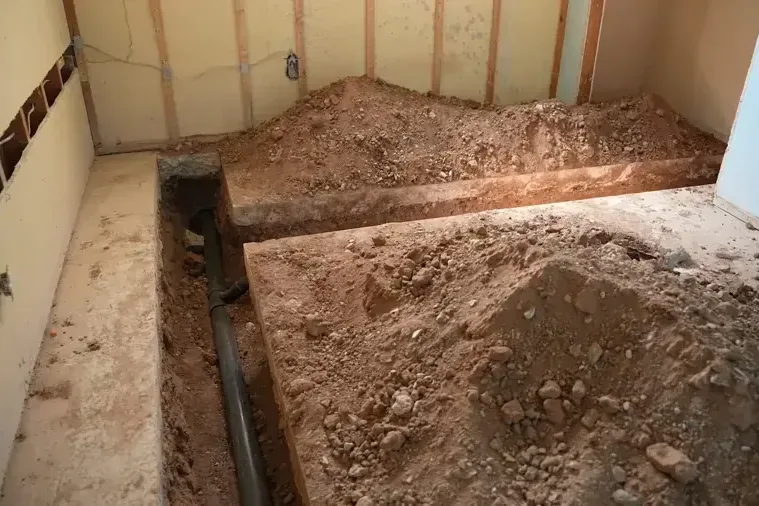
Most Cerritos homes are late 1960s and 1970s tract houses built on concrete slabs, with no basement and no crawl space under the floor. When a pipe leaks beneath that concrete, the water has nowhere to drain, so it moves sideways and up into flooring, baseboards and the bottoms of walls. A slab leak rarely announces itself with a puddle. It shows up as small changes that are easy to explain away.
Key takeaways
- Copper supply pipe under slabs about 50 years old can develop pinholes, and the water it releases stays hidden under the floor.
- Watch for a warm patch on the floor, the sound of running water with every fixture off, a water meter that keeps moving and damp baseboards.
- With no basement to catch it, leaking water spreads through flooring and the bottoms of walls, so the damage is often wider than the visible spot.
- A plumber stops the leak. The restoration team measures and dries the slab, framing and flooring, and both jobs should finish before anything is rebuilt.
- Drying a floor while the pipe is still leaking only moves water around, so the repair and the drying have to be planned together.
Why slab leaks happen in Cerritos tract homes
The tract houses that fill much of the city sit on concrete slabs, and the copper supply pipe that feeds the kitchen, baths and laundry runs under that concrete. After about 50 years in the ground, that pipe can develop pinholes.
A pinhole under steady water pressure leaks day and night in a small, constant stream. That is why the damage builds slowly and the first sign is often a symptom, not a puddle.
A leak like this is the core of slab leak water damage.
Many of these homes have two stories, but the slab sits only under the ground floor. That makes the downstairs rooms the first place trouble shows.
Drain pipe also runs under these slabs, made of cast iron or ABS. A drain leak carries wastewater instead of clean supply water, and it is handled very differently, as described under sewage backup cleanup.
Signs that a pipe is leaking under the floor
A slab leak is a hidden leak, so the signs are indirect. One sign alone proves little, but two or three together deserve attention.
- A warm or hot spot on the floor in a hallway, kitchen or bathroom, where a hot water pipe is leaking.
- The sound of running or hissing water when every faucet, toilet and appliance is off.
- A water meter that keeps turning with every fixture shut off.
- Damp baseboards, wet carpet along a wall, or flooring that cups, buckles or lifts.
- A musty odor in one room that does not clear when the room is aired out.
- A water bill that climbs with no change in how the household uses water.
First steps at home
A homeowner who suspects a slab leak can limit the damage before anyone arrives. The leak source finder helps sort a slab leak from a water heater, a wall pipe, an AC drain, a roof leak or an appliance.
- Turn off every fixture and appliance, then read the water meter. A meter that keeps moving means water is escaping somewhere.
- Close the main water valve at the house. If the floor stays wet or the sound continues, the water may be coming from a different source.
- Photograph wet spots, damaged flooring and the meter reading, with the date visible.
- Lift small rugs, boxes and furniture off the floor and open windows to move air.
- Hold off on cutting into the floor or slab. A plumber's listening and detection tools find the spot and keep the opening small.
- Call a plumber to find and stop the leak, and the restoration team to measure and dry the structure.
How the water moves in a house with no basement
In a house with a basement or crawl space, leaking water drips into an open space where it can be seen or drained. A concrete slab has no such space.
Water from a pinhole follows the path of least resistance along the underside of the flooring, through joints and cracks, and up into baseboards and drywall.
Hardwood and laminate
Planks take on moisture from below, swell at the edges and cup. These floors usually have to come up so the slab can release its water.
Carpet and pad
Carpet that stays wet over a slab holds moisture against the concrete. The pad is normally removed, and the carpet is lifted and dried when it can be saved.
Tile and grout
Tile does not absorb water, but the grout and the setting bed beneath it can, and water can run under tile into the next room.
Walls and cabinets
Water wicks into the bottom of drywall and the toe kicks of cabinets. Baseboards come off, and wall bottoms are opened where readings call for it.

What the restoration team does after the pipe is found
The plumber decides how to repair the pipe. The restoration team works on the water that is already in the house, in three stages.
Mapping the wet area
Moisture meters and thermal imaging show how far the water traveled, including into rooms that look dry.
Opening up and extracting
Standing water and soaked padding are removed, and baseboards come off. Any pooled water is handled through water extraction before drying equipment goes in.
Drying the slab and framing
Dehumidifiers and air movers run until the readings sit within 2 to 4 points of a dry reference. This is the standard measure used in structural drying.
Concrete releases moisture slowly, so the slab is often the last material to reach target.
When a wet floor is not a slab leak
Not every damp floor points to a pipe under the concrete. Other sources leave similar marks, and sorting them out first saves a needless search.
- A wet spot beside a water heater points to the tank or its connections.
- Dampness along a wall shared with a bathroom may come from a shower pan or a supply pipe inside the wall.
- A stain that appears after a storm may trace to the roof or a door threshold.
Questions
Can a slab leak be repaired without breaking the concrete?
Sometimes. A plumber can repair the pipe through an opening in the slab, reroute the supply pipe through walls or the attic, or replace the pipe. The right choice depends on where the leak is and the condition of the rest of the pipe, so the plumber makes that call.
Will a slab leak stop on its own?
No. A pinhole stays open and usually grows. Water keeps moving into the floor until the pipe is repaired.
Why is the damage often wider than the wet spot?
With no space under the floor to hold water, it spreads along the concrete and into baseboards, wall bottoms and the next room. Moisture readings show the true edge of the wet area.
Does the flooring always have to come up?
No. It depends on the material and the readings. Hardwood and laminate often have to come up so the slab can dry, while tile can sometimes stay in place with drying done from the edges.
How long does drying take?
It depends on how much water reached the slab and walls and on the materials involved. The team takes readings at each visit and adjusts the equipment until the numbers reach target.