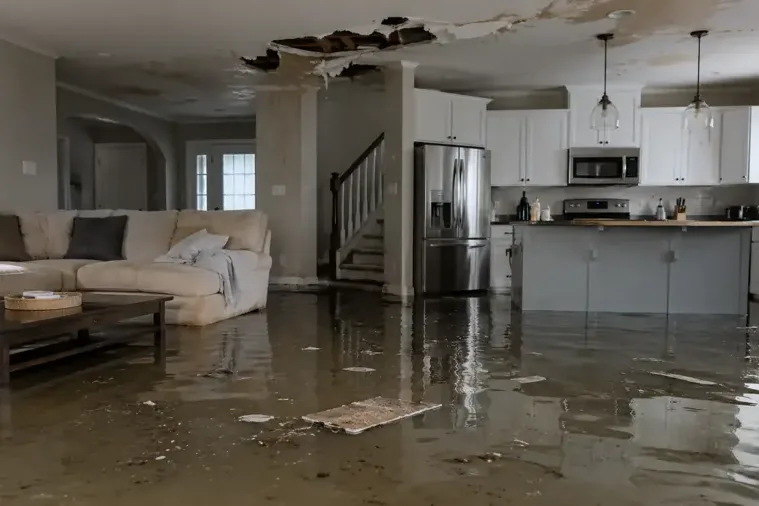
Cerritos gets about a dozen inches of rain a year, and most of it falls in a few winter storms between November and March. When an atmospheric river arrives, runoff can cross a flat street and a driveway and slip under the garage door onto the slab. The water that comes in is not clean, and the first day decides how much of the garage, the laundry room and the wall bottoms can be saved.
Key takeaways
- Runoff that enters under a garage door is treated as contaminated water, so soaked porous materials are removed, not dried in place.
- A garage slab dries slowly, and water can travel from the garage into the house through the door threshold and the shared wall.
- Photograph the high water mark, the stored items and the door before anything is moved.
- Stay out of standing water until the electrical circuits near it are safe, and keep children and pets away from the wet area.
- Cardboard, carpet and pad, insulation and drywall that sat in the water usually go, while hard items can often be cleaned.
Why Cerritos garages catch storm water
The city sits on flat ground, and its streets give runoff little slope to drain away on. In a heavy storm the water can pond at the curb, rise across the driveway and push under the garage door.
The February 2024 atmospheric river storms flooded streets across Los Angeles County, a reminder of how much water a single storm can deliver to a flat, paved area. Coyote Creek runs in a flood control channel along the eastern edge of the city, and the San Gabriel River channel lies west of town along the 605.
Cerritos homes are tract houses on concrete slabs with no basement, so water that gets in spreads across the floor instead of draining below.
Garages in these homes often hold the water heater, the washer and dryer, and years of stored boxes, all of which sit close to the floor.
What is in the water
Whatever its source, water that crosses a street and a driveway picks up soil, oil, trash and bacteria on the way. That is why storm and flash flood cleanup treats it as contaminated water, not as a clean leak from a pipe.
- Wear waterproof boots and gloves when walking through the wet area.
- Do not run a household vacuum or a fan on a wet extension cord.
- If the water reached a water heater or an electrical panel in the garage, stay away until the power is off.
- Wash hands and boots after leaving the garage, and keep wet shoes out of the living areas.
The first day, step by step
The order matters. Safety comes first, then proof, then the water.
- Make sure the area is safe, with power off to any wet outlets and the water heater area checked.
- Take photos of the high water mark on walls and boxes, the door gap, and anything stored on the floor.
- Once the rain eases, block the gap under the door with towels or sandbags to slow any more water.
- Lift dry items onto shelves or tables, and set aside the ones that are already soaked.
- Call the extraction crew to remove the standing water and measure how far it traveled.
What goes and what stays
Porous materials that sat in storm water absorb the contamination, and they are hard to clean. Hard, sealed items can be washed and disinfected.
Items that usually go
Cardboard boxes, fabric, carpet and its pad, insulation and drywall that stood in the water are the usual removals. Upholstered items and stored paper fall in the same group.
Items that can often be cleaned
Metal tools, plastic bins, glass and sealed wood can usually be washed and disinfected. Anything electrical should be checked before it is plugged in again.
When the water reaches the house
The door between a garage and the house is a weak point. Water can pass under the threshold into a laundry room, a hallway or a kitchen, and it can wick up the bottom of the shared wall.
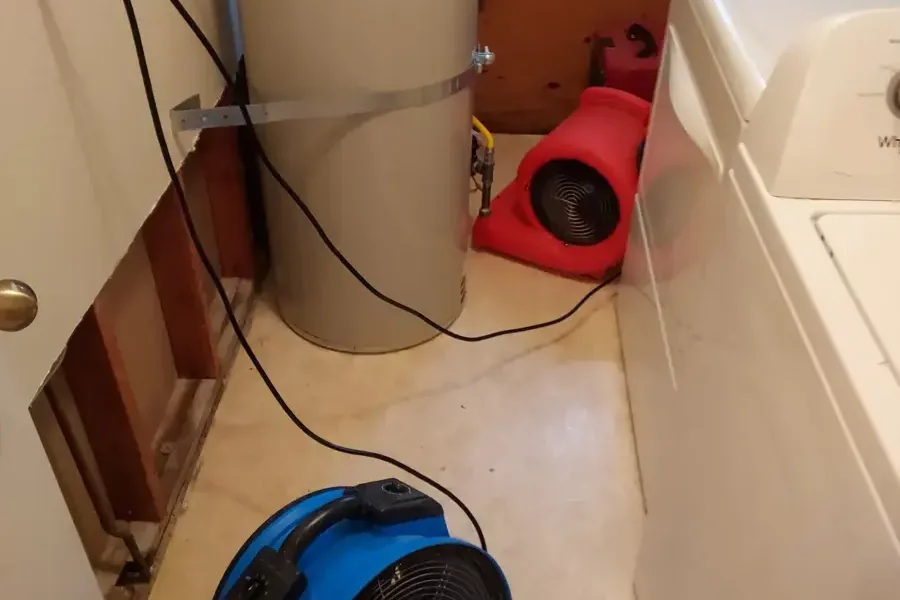
The crew checks the rooms beside the garage with a moisture meter, since a floor that looks dry can still hold water in the baseboards or the drywall. Standing water goes first through water extraction, and then the cutting begins where readings show wet drywall.
- Baseboards come off so the wall bottom can be checked and aired.
- Wet drywall is cut out above the high water mark so the framing can dry.
- Flooring that carries storm water into the house is lifted and checked.
Drying the garage slab and the rooms next to it
A concrete slab holds moisture longer than most people expect. Dehumidifiers and air movers run until readings fall within 2 to 4 points of a dry reference, which is the target used in structural drying.
The drying time estimator shows how the source of the water and the time of year change the expected pace. In the cooler, damp months the garage can feel dry long before the framing and the slab are.
Waiting does not help. Wet drywall and carpet start to break down quickly, usually within 24 to 48 hours, and a musty smell in the laundry room is often the first sign that wall bottoms stayed wet.
Getting the garage ready for the next storm
Since most of the year's rain arrives in a few winter storms, a little work before November pays off. None of it makes a garage waterproof, but it lowers the amount of water and the amount of loss.
- Store boxes and paper on shelves, not directly on the slab.
- Clear leaves and debris from the driveway and the curb so runoff has a path away from the door.
- Check the seal along the bottom of the garage door and replace it if it is cracked or missing.
- Keep towels or sandbags where they can be reached quickly.
- Know where the main water valve and the electrical panel are, in case the garage floods while the household is away.
Questions
Is storm water that comes under a garage door really contaminated?
Yes. Runoff crosses streets and driveways before it gets in, and it can carry soil, oil and waste. It is handled as contaminated water, which is why soaked porous materials are removed.
Can a wet vacuum handle it?
A shop vacuum may take up a small amount, but contaminated water on a slab leaves residue and moisture behind. Extraction with proper equipment, followed by cleaning and drying, is the safer route.
Can the water get into the walls?
It can. Drywall wicks water up from the floor, and at the door to the house water can pass under the threshold. Moisture readings show whether the wall bottoms are wet.
Do sandbags stop storm water?
Sandbags can slow and divert water at a door, but they do not make a door watertight. They work best placed before the water arrives and combined with clearing the driveway of debris.
What if another storm is coming?
Storms often arrive in clusters during the wet months. Removing wet materials and starting the drying early keeps the next round of water from landing on a floor that is still wet.